The tontine: what it gives, what it costs
Rotating tontine or savings group, implicit rate by turn, auctions and the risk of default.
Lesson 39 min
By the end of this lesson
- Tell a rotating tontine from a savings group
- Work out a tontine’s implicit rate by turn, with or without an auction
- Name the main risk of a tontine and some safeguards
In this lesson4
In the neighbourhood, at the market, at the office, the tontine is often the first "bank" people know. It pays no interest, and yet it is useful. The lesson "Tontine or fund: borrowing, saving, investing" showed that your turn changes everything. What this one teaches: telling apart the two main forms of tontine, working out a tontine's implicit rate according to your turn, and spotting its risks.
Two kinds of group
Tontine
A group of people who regularly pay the same amount into a common pot, which is paid out to each member in turn.
This is the rotating tontine: the World Bank calls it a rotating savings and credit association; in sub-Saharan Africa, 25% of adults saved in 2021 in a club of this kind or with someone outside the family (Global Findex 2021).
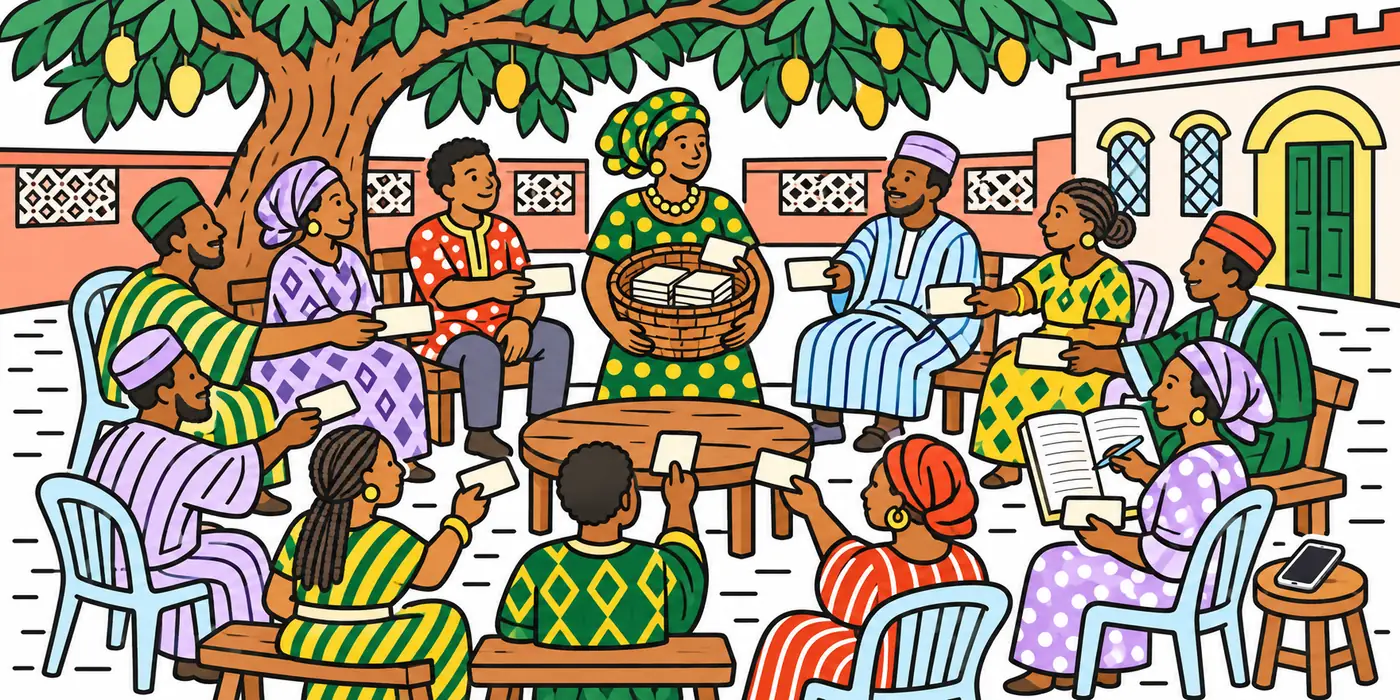
The second model keeps the money instead of handing it out. CGAP, a research centre hosted by the World Bank, describes savings groups: 15 to 25 people who choose each other, save at every meeting, lend the common fund to their members for interest, then share out the savings and the interest at the end of a cycle of 9 to 12 months (CGAP, "Savings Groups").
Savings group
A group that builds up its members' savings in a common fund, lends it to them for interest, then shares out the savings and the interest at the end of the cycle.
| Rotating tontine | Savings group | |
|---|---|---|
| The pot | paid in full to one member each round | kept and lent to members |
| Interest | none | paid by those who borrow, shared at the end |
| What you get back | exactly what you paid in | your savings plus your share of the interest |
From memory: in which kind of group is the fund lent for interest instead of being paid out in turn?
The implicit rate according to your turn
The implicit rate is the interest rate you pay or receive without it being written anywhere: you find it by comparing what you receive and what you pay, and when.
12 friends, 10,000 FCFA a monthFictional
The pot is worth 12 × 10,000 = 120,000 FCFA. Each member receives it once.
- Turn 1, Junior. In month 1, he pays 10,000 and receives 120,000: he has 110,000 FCFA, which he then pays back in 11 payments of 10,000, that is 110,000. He pays back exactly what he received: his implicit rate is 0%. It is a free loan.
- What this free loan saves him. A fictional loan of 110,000 FCFA at 2% a month, repaid over 11 months, would cost about 11,240 FCFA a month, that is 11 × 11,240 ≈ 123,640 FCFA: about 13,640 FCFA of interest avoided.
- Turn 12, Clarisse. She pays 10,000 for 12 months, that is 120,000, and receives 120,000 in month 12. Implicit rate: 0% as well. It is saving without interest; if prices rise during the year, her 120,000 FCFA buys a little less than at the start.
In a plain rotating tontine, nobody pays or receives interest: the implicit rate is 0% for everyone. The first member gains (he borrows for free), the last loses a little (she lends for free, and inflation nibbles away).
When the first pays to go first
Some tontines auction the turn: members offer a price to receive the pot earlier. Researchers who studied such bidding tontines in South India note that the first served then pay an interest rate (Klonner and Rai, 2005).
Junior accepts a discount of 12,000 FCFA (fictional rule)Fictional
To go first, Junior agrees to receive 120,000 − 12,000 = 108,000 FCFA; the 12,000 is shared among the other members.
- What he gets in month 1. 108,000 received minus his 10,000 paid in: 98,000 FCFA.
- What he pays back. 11 payments of 10,000, that is 110,000 FCFA.
- The cost. 110,000 − 98,000 = 12,000 FCFA for having 98,000 FCFA straight away.
- The implicit rate. We look for the monthly rate at which 11 payments of 10,000 are worth 98,000 today. At 2% a month they would be worth about 97,870 FCFA, a little less: so the rate is just under 2%, about 1.98% a month, or nearly 26% a year.
Writing for the sum obtained straight away, for the monthly payment, for the number of payments left and for the monthly implicit rate:
You find by trial and error, as in step 4: if the result is too small, the rate you tried is too high.
Without looking back: in a rotating tontine of 10 members with no auction, what is the implicit rate of the first and of the last member?
The risks
- A member defaulting. Whoever received the pot early still owes the group a lot; if they stop paying, the members after them lose. A study of tontines in Kenya concludes that, without a social sanction from outside the group, a tontine is never sustainable: everything rests on group pressure and on how the group is organised (Anderson, Baland and Moene).
- The pot held by one person. If that person disappears with the money, no remedy set out in any text was found.
- No legal framework found. No COBAC or BEAC text governing rotating tontines was found for this lesson.
A few safeguards, in principle: a group of people who know each other, written rules, a record of payments, an order of turns decided in advance.
An honest tontine pays back exactly what was paid in, or what was paid in plus the interest paid by members. A "tontine" that promises to double your stake without lending to anyone works like a pyramid: see the lesson on scams.
Your turn
Read next: CGAP, « Savings Groups » (2011)
A question? Ask your teacher, or an AI assistant, giving it the title of this lesson.