Before the exchange: fairs, bills of exchange and the Bruges square
From the Champagne fairs to the Van der Buerse square: the exchange is born when merchants meet every day in the same place.
Lesson 19 min
By the end of this lesson
- Explain what a bill of exchange allowed a merchant to do
- Distinguish a periodic fair from a place where people trade every day
- Trace the path of the word “bourse”, from Bruges to Antwerp, saying what remains uncertain
In this lesson5
Before it is a building or a screen, an exchange is a habit: merchants meeting every day in the same place to swap payments, goods and news. What you will take from this lesson: the exchange is born when the great market that comes back a few times a year becomes a market that never closes, and its name comes from a square in Bruges.
Fairs: a great market that comes back
In the Middle Ages, long-distance trade went through fairs. The Champagne fairs were held in four towns, with six meetings a year “in the decisive period 1125-1175”, and a fair “in theory lasted 52 days”. Italian merchants are recorded in France as early as 1074; in the early 13th century, the lenders who advanced large sums there were Italian, notably from Siena (Henri Dubois, “Les foires dans la France médiévale”, IGPDE).
A fair gathers everyone, but only for a while. Between two fairs, anyone who has to pay or be paid waits for the next meeting.
The bill of exchange: paying without carrying the money
Carrying coins over hundreds of kilometres is costly and invites theft. Italian merchants used a document that made the payment travel instead of the money.
Bill of exchange
A written order by which one person, the drawer, tells another, the drawee, to pay a set sum, on sight or on a given date, to a third person, the payee (Office québécois de la langue française).
According to Dubois, the bill of exchange grew out of an exchange contract made before a notary: little by little, “the exchange, now fictitious, gave way to the credit”. The notarial archives of Genoa, from 1190 onwards, shed light on its beginnings; endorsement, which lets the bill be passed on to someone else, “perhaps existed by 1410 and more surely in 1430” (Dubois).
Three names on one piece of paperFictional
Ama, a cloth merchant (fictional), sells a bolt to Bruno at the fair of Lisière (a fictional town). Bruno does not have the 300 écus on him, but his partner Carlo, in Portval (fictional), owes him money.
- The drawer. Bruno writes a bill: “Carlo, pay 300 écus to Ama in 60 days, in Portval.”
- The drawee. Carlo receives the order to pay. He is the one who will hand over the money.
- The payee. Ama keeps the bill and gets paid in Portval in 60 days.
- What travelled. A piece of paper, not 300 écus. Ama has given 60 days’ credit: she must trust Bruno and Carlo.
From memory: in a bill of exchange, who gives the order, who pays and who receives the money?
Bruges: a market that never closes
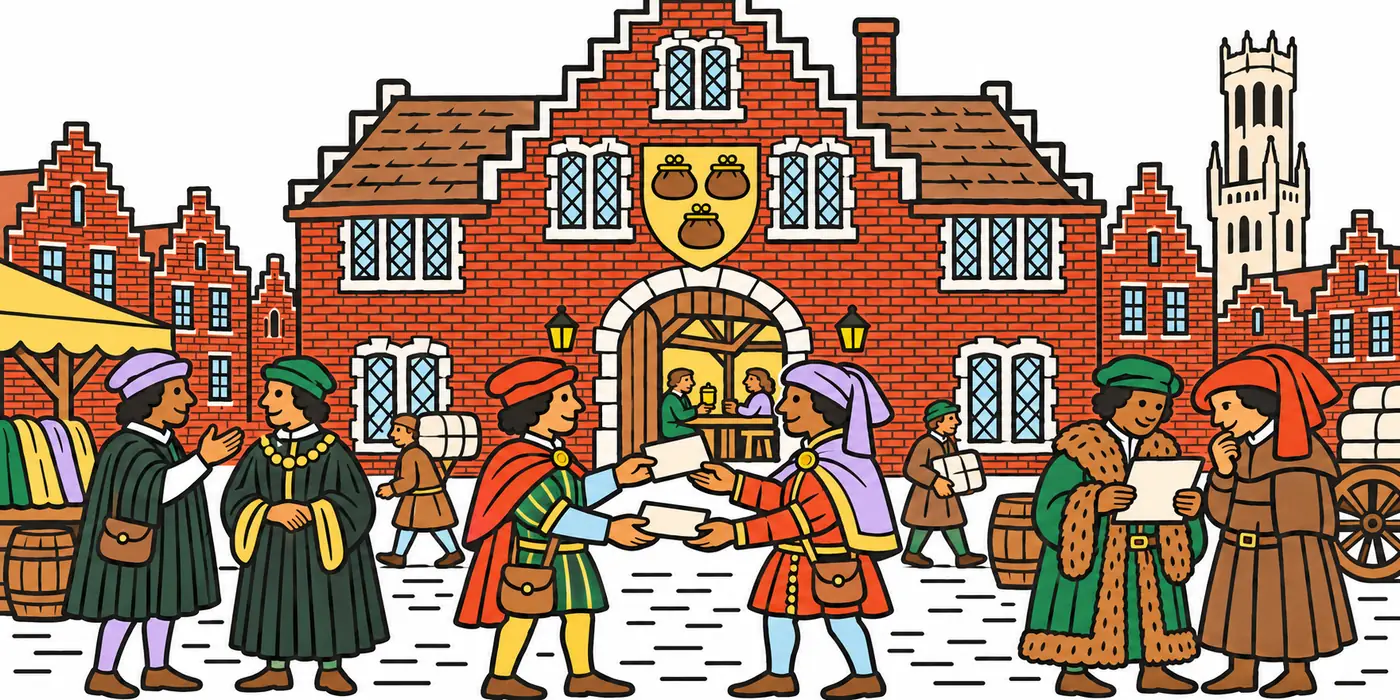
In the 14th century, the Hundred Years’ War (1337-1453) made the road risky and expensive; merchants preferred the sea. Bruges, close to the sea and linked to the Hanseatic League, attracted Castilians and Italians. From the middle of the 14th century, merchants of many nations traded around the inn of the Van der Beurse family. The historian Lodewijk Petram stresses the difference from the fairs: Bruges became a centre of the trade in bills of exchange, and business was done every day, summer and winter (Petram, The Low Countries, no. 21).
The museum of the National Bank of Belgium adds detail: the Van der Buerse family ran the Ter Buerse inn for five generations, Robrecht Van der Buerse was running it by 1285, and the family’s coat of arms showed three purses. In the 14th century, the square in front of the inn became the city’s commercial and financial centre; the exchange rates of several cities were published there from 1370. In 1495, the German physician Hieronymus Münzer noted that Bruges had a square where merchants gathered, called “De Beurs” (NBB Museum).
Stock exchange
The organised market where people who want to buy and people who want to sell shares and bonds meet.
In Bruges, nobody traded shares yet: people traded bills of exchange, goods and news. But two features of the exchange were already there: a fixed place and a daily session.
Without looking back: what was new in Bruges compared with the Champagne fairs?
The word travels: Antwerp, then Europe
Bruges remained Europe’s leading trading centre for about 150 years, then gave way to Antwerp in the 16th century: its harbour silted up and the Hanseatic League declined. Antwerp built, behind the Meir, a building designed for trade, whereas in Bruges people had traded in an inn and on a square (Petram). A Latin inscription described it as “for the use of tradesmen of all countries and languages” (Baker Library, Harvard).
The word followed the market. According to the NBB museum, “beurs” first meant the square in Bruges; in Antwerp people spoke of “the new beurs”, and the word spread: bourse, borsa, bolsa, Börse. In England, “Burse” was used from 1550 to 1775 (NBB Museum). London’s first Royal Exchange opened in 1567 (Baker Library).
- 1074
Italians in FranceEurope
Italian merchants are recorded in France.
- 1125-1175
Champagne fairsEurope
Four towns, six meetings a year: the decisive period according to Dubois.
- 1285
The Ter Buerse innEurope
Robrecht Van der Buerse runs the inn in Bruges.
- 1370
Rates publishedEurope
The exchange rates of several cities are published on the Bruges square.
- 1495
“De Beurs”Europe
Hieronymus Münzer describes the Bruges square where merchants gather.
- 1531-1532
Antwerp exchangeEurope
A building designed for trade, open to merchants of every language.
- 1567
Royal ExchangeEurope
London opens its first Royal Exchange.
- 1585
Antwerp fallsEurope
The city surrenders on 17 August after a siege; the Scheldt is closed and trade moves to Amsterdam.
The exact origin of the word “bourse” is debated. The NBB museum considers the name and coat of arms of the Van der Buerse family “undoubtedly decisive”, but other writers point to the Latin bursa, a leather bag. Take the Bruges square as the best-supported account, not as a certainty. The date of the Antwerp exchange also varies: built in 1531 according to the magazine The Low Countries, dedicated in 1532 according to the Baker Library.
And today
The market that never closes has become the rule. Since late 2023, the BVMAC has held its auction every business day, Monday to Friday, instead of three sessions a week (Notice no. 057/2023/BVMAC/DG). The story continues in Amsterdam, where people began trading shares in companies: see “Amsterdam, a share that changes hands” and then the next lesson.
Your turn
A question? Ask your teacher, or an AI assistant, giving it the title of this lesson.